Cut Airborne Contaminants and Protect Brand Standards with Office Curtain Cleaning
Office curtain cleaning is one of the most overlooked tasks in commercial facility maintenance, yet it directly affects indoor air quality, employee health, and the professional image your space projects to every client who walks through the door.
Here is a quick reference for facility managers making decisions about window treatment maintenance schedules
| Factor | Recommended Action |
|---|---|
| Standard office environment | Professional cleaning every 3-6 months |
| High-traffic or open-plan offices | Clean every 3 months |
| Medical or compliance-sensitive facilities | Clean more frequently based on audit requirements |
| Routine maintenance between deep cleans | Weekly microfiber dusting; monthly vacuuming with upholstery attachment |
| Blinds | Full cleaning monthly; dust in between |
Office curtains and window treatments trap fine dust particles, allergens, HVAC pollutants, and even mold spores deep within their fibers. In commercial settings, that buildup affects occupant comfort, can undermine cleanliness audits, and sends the wrong message to clients and employees. A building-specific maintenance plan solves that problem by treating window coverings as part of the facility’s air quality and appearance program.
My name is Dave Spinks, and after nearly three decades managing commercial facility operations across Indianapolis, I have seen how a disciplined approach to office curtain cleaning protects both the people inside a building and the long-term value of the assets that furnish it. At Office Keepers, our family-owned company has served local organizations since 1978 with in-house teams who understand the standards expected in offices, medical buildings, and institutional environments. In the sections below, I will show you the professional methods, scheduling frameworks, and material-specific protocols that help facility leaders reduce risk and maintain a stronger workplace standard.
Office curtain cleaning terms to learn
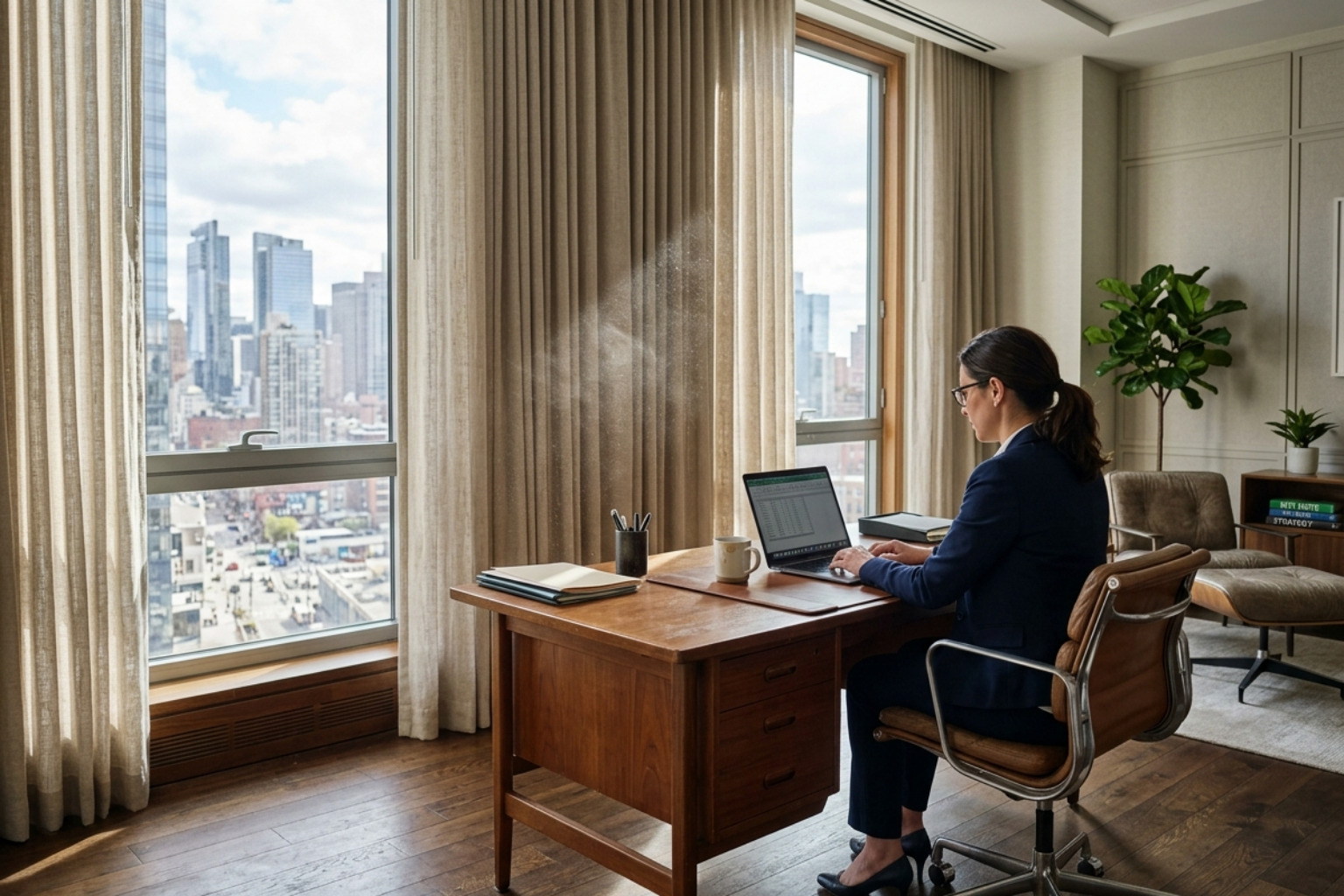
Clean window treatments protect client confidence, support employee morale, and reduce avoidable indoor air quality complaints. In a corporate setting, stained or dusty drapes signal weak oversight. In a regulated environment, neglected fabrics can add to allergen load and create audit concerns. The resolution is a facility-specific plan handled by an in-house commercial team that knows the building, the occupants, and the operational constraints.
Effective facility maintenance requires viewing curtains not just as decor, but as functional air filters that eventually become saturated. Our approach at Office Keepers focuses on preserving the structural integrity of these assets while ensuring they meet the hygiene standards expected in modern workplaces. From law firms in Carmel to medical centers in Castleton, the goal remains the same: a workspace that looks pristine and supports the physical well-being of every occupant.
Reduce Sick Building Complaints with a Predictable Office Curtain Cleaning Schedule
Poor air quality affects comfort, morale, and productivity long before it becomes a formal complaint. In commercial buildings, curtains collect fine dust, pollen, and HVAC particulates that recirculate through occupied space. The practical fix is a scheduled service interval built around traffic levels, ventilation demands, and the specific risk profile of the facility.
For most workplaces, professional curtain cleaning every 3 to 6 months helps keep buildup from becoming an operational issue. For facilities in high-traffic areas or those near industrial zones in Noblesville and Fishers, a 3-month cycle is often the better standard. Regular office cleaning schedules should include these fabrics so they do not become a hidden source of indoor air quality problems. For more insights on the technical aspects of fabric care, you can review How to Clean Practically Anything.
Protect Compliance and Extend Asset Life with Advanced Office Curtain Cleaning Methods
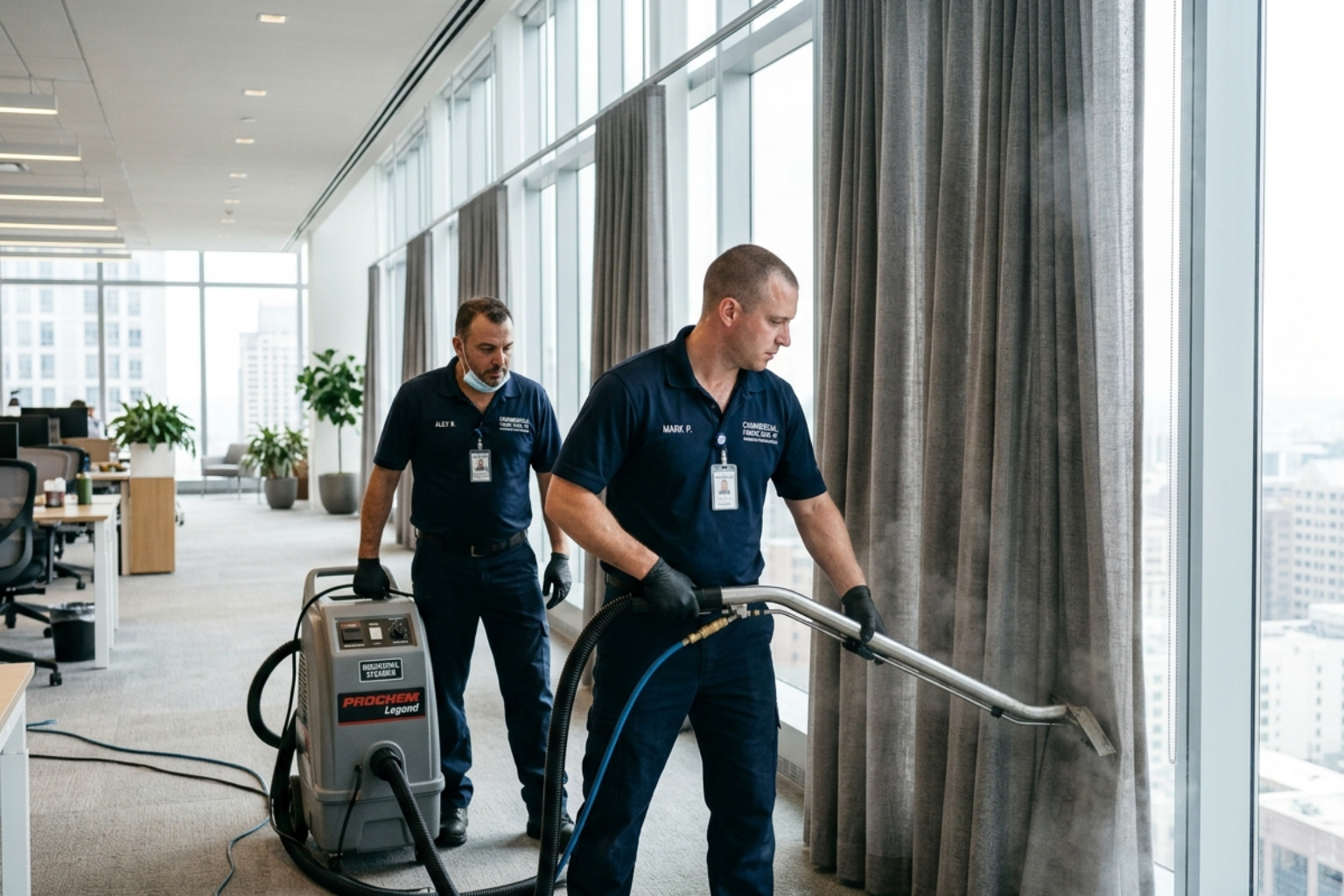
Poor cleaning methods create real risk in commercial facilities. They can damage expensive window treatments, disrupt operations, and create moisture conditions that lead to mold concerns. The resolution is to use specialized equipment, in-house technicians, and a building-specific scope of work that matches fabric type, occupancy needs, and compliance requirements.
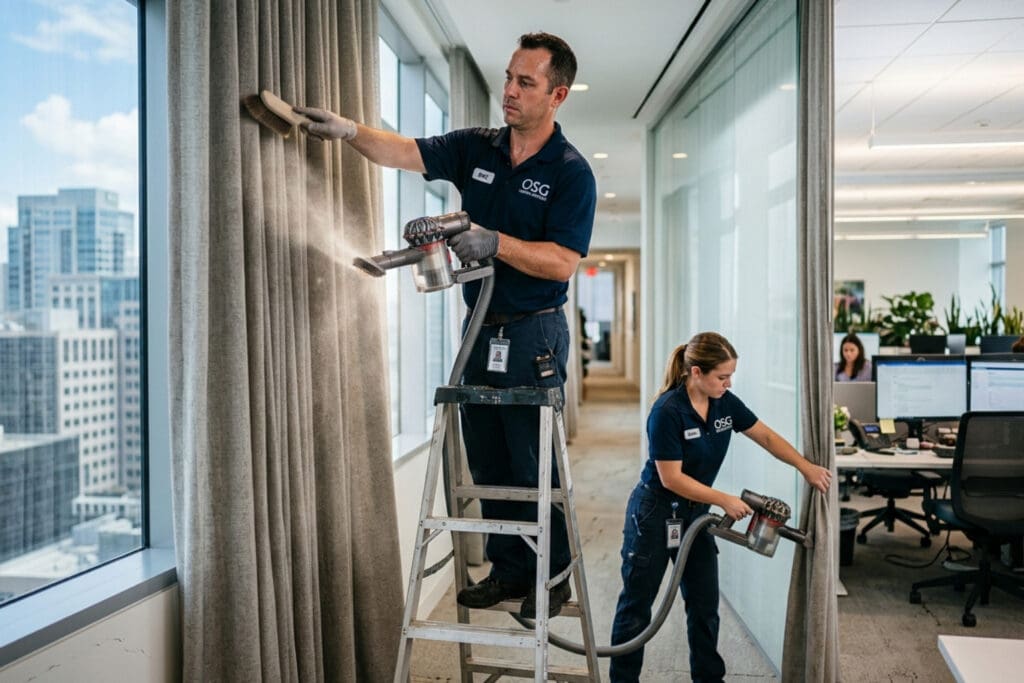
Professional office curtain cleaning relies on specialized equipment that far exceeds standard janitorial tools. We use several advanced methods depending on the fabric type and the facility’s needs. On-site dry cleaning is often the preferred choice for large-scale operations because it allows for deep sanitation without the downtime associated with removing and rehanging heavy drapes. This process uses pressurized solvent injection and extraction to pull dirt from deep within the fibers without soaking the material.
In environments where hygiene is non-negotiable, such as medical facilities, we may employ HEPA-filtered vacuuming followed by ultrasonic cleaning for blinds. This ensures that even microscopic contaminants are removed. Our janitorial teams are trained to handle these high-stakes tasks with precision, ensuring that the cleaning process itself does not introduce moisture that could lead to mold growth.
Preserve fire-retardant compliance during office curtain cleaning
A major compliance risk in commercial buildings is the accidental loss of fire-retardant performance during cleaning. Many curtains are treated to meet NFPA 701 standards and local fire code requirements. The right resolution is a non-immersion process managed by trained in-house technicians who understand fabric chemistry and compliance exposure.
We prioritize non-immersion cleaning methods that protect these chemical bonds. By using dry-solvent techniques, we help the fabric maintain its fire-resistant properties throughout its service life. This is a critical part of OSHA compliance and general facility safety. For a deeper look at the technical standards of non-immersion methods, the Canadian Drape and Curtain Cleaning Methods provides a solid foundation for understanding why immersion is often avoided in professional settings.
Commercial curtain cleaning reduces operational risk and replacement cost
Facility leaders need cleaning partners who can work within active business environments without creating liability. In commercial spaces, mistakes can lead to expensive fabric replacement, compliance problems, or disruption in executive and patient-facing areas. The resolution is an insured provider with background-checked in-house employees and clear building protocols.
Professional services involve full liability insurance and background-checked employees who understand the nuances of high-stakes environments. Offices also face soils such as toner dust, ink, and industrial particulates that require specialized chemistry and process control. Our commercial carpet cleaning and upholstery services use industrial-grade chemistry designed to break down these specific contaminants while being safe for office occupants.
Match the Right Cleaning Protocol to Each Window Treatment and Avoid Premature Replacement
Using the wrong method on commercial window treatments leads to visible damage, shorter service life, and unnecessary replacement cost. The solution is a building-specific maintenance plan that matches each treatment type to the right process, equipment, and service interval.
Different window treatments require distinct maintenance paths. Synthetic fabrics like polyester are often chosen for their durability and stain resistance, making them ideal for high-traffic zones. Natural fibers like silk or wool, often found in executive suites in Zionsville or Westfield, require a much gentler touch and strict dry-clean-only protocols to prevent shrinkage.
| Fabric/Treatment Type | Primary Cleaning Need | Recommended Method |
|---|---|---|
| Synthetic (Polyester/Vinyl) | Dust and grime removal | Damp wiping or low-moisture extraction |
| Natural Fibers (Silk/Wool) | Allergen removal | Professional on-site dry cleaning |
| Blackout Linings | Preservation of coating | Solvent-based cleaning; avoid heat |
| Venetian Blinds | Dust accumulation | Microfiber dusting and ultrasonic baths |
| Motorized Roller Shades | Mechanical protection | HEPA vacuuming and spot treatment |
High-end offices often use motorized shades or pleated curtains with delicate blackout linings. These linings are particularly sensitive to heat and can crack or peel if subjected to standard steam cleaning. Our in-house teams use planned maintenance methods that protect these surfaces and help facility managers extend the life of a significant furnishing investment.
Prevent mold, control odor, and keep audits on track with professional fabric maintenance
Facility managers are usually dealing with three recurring issues at once. Odor complaints, mold risk near glass lines, and questions about cleaning frequency all point back to one problem. Fabric surfaces hold contaminants until a professional process removes them. The fix is a scheduled commercial service plan backed by an in-house team that understands the building and its risk areas.
Managing a large facility means fielding questions about why certain protocols are in place. One of the most common concerns is mold prevention. In many Indianapolis buildings, condensation on windows can seep into curtain hems. Professional cleaning includes anti-microbial treatments that prevent mold and mildew from taking hold.
Another priority is odor control. Fabrics act as a sponge for smells, including food from breakrooms or smoke from nearby industrial processes. Deep cleaning removes the source of these odors rather than just masking them. For more on how we maintain a healthy workspace, visit our page on sanitizing surfaces.
High-traffic office curtains need quarterly cleaning to reduce complaints and wear
In high-traffic areas, delayed service usually shows up as odor, dust buildup, and visible discoloration. That affects employee perception and can weaken the experience for visitors and clients. The practical standard for most busy commercial spaces is professional cleaning every 3 months.
The sheer volume of people moving through the space kicks up floor dust and skin cells that eventually settle into the window treatments. Waiting longer than 6 months allows these particles to bond with the fabric fibers, making them much harder to remove and potentially causing permanent discoloration.
Improper laundering creates shrinkage, lining failure, and compliance risk
The wrong cleaning process can damage commercial drapes, distort hems, and weaken treated fabrics. For facility managers, that means replacement cost, appearance issues, and possible compliance exposure. The answer is a professional process designed for commercial-grade materials and installation conditions.
Improper washing methods can cause significant shrinkage in linings and seams, often leaving the curtains uneven and unable to close properly. Many detergents also lack the pH balance required to clean industrial soils without damaging the fabric’s fire-retardant coating.
On-site service cuts downtime and protects privacy in active facilities
Removing window treatments from an occupied building creates disruption, privacy issues, and added handling risk. On-site service solves that by keeping treatments in place while restoring cleanliness and appearance. That is why it is often the preferred option for large commercial properties.
On-site cleaning reduces the risk of damage during transport and the labor costs of removal and reinstallation. It also ensures that the windows are never left bare, maintaining the building’s professional appearance and privacy throughout the cleaning process. This method is efficient and minimizes disruption to office operations, allowing work to continue while air quality and presentation are being improved.
Transfer the burden of fabric maintenance to a family-owned Indianapolis partner with in-house teams
Facility leaders do not need another vendor that adds supervision work back onto their staff. They need a reliable partner who can assess the building, build the plan, and execute it with accountable in-house employees. That is the operational shift we provide.
Since 1978, Office Keepers has been a dedicated partner to the Indianapolis business community. With nearly three decades of local facility operations experience, I have seen how consistent service planning protects both building standards and internal teams. We are a family-owned company, and we do not use subcontractors. We rely on our own background-checked employees to deliver consistency, accountability, and long-term service stability.
Our approach is not about a generic checklist. We provide facility-specific evaluations to create a cleaning plan that fits your operational needs and protects your brand image. By focusing on the health of the workspace through specialized office curtain cleaning and comprehensive maintenance, we help you provide a safe, productive environment for your team.
If you are ready to move this responsibility off your internal team, we invite you to request a strategy session for your facility. We will evaluate your building, identify the risk points, and build a practical maintenance plan around your operations.